
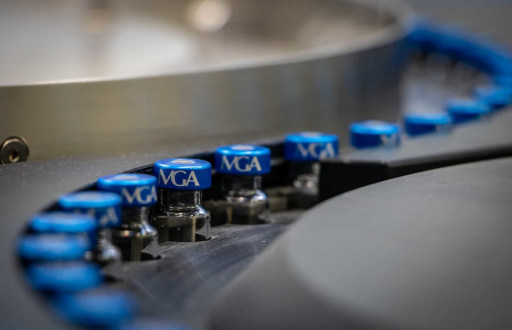





































In an industrial process, the packaging line is the final stage. In the pharmaceutical industry, its role is to convey the products that are to be packed. It can be run by an operator or controlled from a computer workstation, and it can also be driven by a programmable logic controller (PLC) or operated semi-automatically. MGA Technologies designs custom primary packaging machines for this type of application.
Need for a Packaging Line in the Pharma Industry
A packaging line in the pharmaceutical industry must be designed to limit the generation of mechanical particles and to make batch changes, line clearance and machine cleaning easier. Packaging lines cover many applications that require real expertise in clean design, including the management of the flow of products to be overwrapped and their distribution.
The packaging line and its functional layout must also offer a high level of operator safety and optimal ergonomics. In the pharmaceutical environment, particular care must be taken in the handling and distribution of the products to be packaged in order to preserve their integrity.
Many companies offer packaging lines for the pharmaceutical sector, including MGA Technologies, a French company. For more than 40 years, MGA Technologies has been working with pioneers of the biotech, medical, mechanical and pharmaceutical industries. It designs and builds custom machines dedicated to the transfer and assembly of clean or sterile products.
Pharma Product Packaging Lines by MGA Technologies
MGA Technologies offers several custom pharmaceutical packaging solutions, including the automatic kit preparation line, the pharmaceutical filter packaging machine and the pharmaceutical filter transfer machine. Each is designed for the specific needs of primary or secondary packaging.
Automatic Kit Preparation Line
This automatic kit preparation line prepares kits for use with pathogen detection equipment. It is organized around a central pallet transfer system that receives the many components making up each kit, and is installed in a building specially designed for this type of pharmaceutical production.
Each pallet is equipped with an RFID tag that tracks its status and validates every step of the process. This provides individual quality tracking and ensures that every kit is prepared correctly. A central PLC controls the entire line and communicates the production data and the status of the various stations, which can be displayed on screens placed anywhere in the workshop.
Upstream, an automatic carton former unstacks and erects the two possible carton sizes, large or small, before they are labeled and placed on the pallets. Each label is then checked by a vision system to verify the quality of the printed Data Matrix code.
Operators load the side conveyors with thermoformed trays containing the test strips from three adjustable ergonomic stations. A cleated conveyor then feeds a stacker that forms stacks of five trays, and a manipulator inserts these stacks into the cartons, in one or two stacks depending on carton size.
A cardboard insert is then unstacked, formed and placed in the carton next to the stacks of strips. At the next station, two belts present the vials to two high-speed SCARA robots, which place them precisely in the insert. The line can handle up to around a hundred recipes, combining different vial types and sizes. The following three stations visually check the previous steps, insert the instructions for use and add a dedicated straw.
The next station features an air dispenser that unstacks pouches containing small plastic tools. An orienter and a separator identify them by vision before labeling, and each label is checked for print quality and marking compliance. One or two pouches are inserted depending on carton size. The cartons are then removed from the pallet transfer for inspection, and non-compliant products are set aside for the line operator to check.
Compliant cartons are closed automatically by an integrated carton closer, then conveyed to a six-axis articulated robot. The robot palletizes the cartons and inserts an anti-slip sheet every two layers. Two pallets are built in parallel so that the line does not stop when a pallet is replaced.
Pharmaceutical Filter Packaging Machine
Between two production steps, pharmaceutical filters can be temporarily packaged using this custom-built machine. At the exit of the upstream machine, a 6-axis robot automatically forms a stack of filters.
A cardboard box with a plastic liner is fed into the robot cell on a motorized roller conveyor. A manipulator presses the liner against the walls of the box, which is oriented to make it easier to insert the stack that has been formed.
The custom machines and packaging lines for pharmaceutical products built by MGA Technologies are developed for liquid, powder and solid products. They can include a primary packaging stage, the preparation of the necessary packaging and its closing.
The lines can therefore integrate the whole process: from filling the container, through primary packaging and the preparation of the packaging, to its closure (by welding, screwing, crimping, heat-sealing or sealing).
Quality control is carried out by vision or using other types of sensors specific to the application. Whenever a customer needs an application for which no suitable standard machine exists, because of specific constraints or the need to integrate advanced technologies, MGA Technologies can provide a dedicated solution.
In most cases, batch traceability and identification are managed by printing directly on the packaging (see our marking solutions for production lines).
Automatic Syringe Packaging and Unpacking Machine
This machine comprises two lines. They unpack syringes supplied in strips, an essential step before the syringes are repacked into higher-capacity trays for autoclaving. After the autoclave, the trays are processed by a second machine that unpacks them and counts the syringes.
The machine can process up to 16,000 syringes per hour, allowing manufacturers to optimize their productivity. It is designed in compliance with current standards, including cGMP (current Good Manufacturing Practices).
Automatic Filling Line for Heat-Sealed Plastic Strips
This pharmaceutical packaging equipment dispenses, assembles and packs strips containing diagnostic liquid used to detect foodborne pathogens.
The automatic strip filling line features a station of 16 volumetric pumps that fill the wells with test liquid. The strips are then covered with an aluminum film that is heat-sealed, and a labeler applies a label to the film to identify each strip. The strips are then separated, and each one is packed individually into thermoformed trays. The line can produce up to 5,300 strips per hour.
Revamping of a Filling and Labeling Machine in a Cleanroom
MGA Technologies does not only design and build pharmaceutical packaging equipment. We also revamp existing equipment, such as a machine for dispensing, filling, capping and labeling glass vials in a cleanroom. One of our projects involved a German-built cam-driven machine: by replacing its automation, software and hardware, as well as its sensors and cables, MGA Technologies enabled it to produce 4 ml and 8 ml vials containing lyophilized product or liquid.
We also fitted the machine with a new electrical cabinet including an HMI and a PLC, and integrated other custom equipment: change parts (trays, rails, etc.), automatic distribution of plastic caps using vibrating bowls and rails, and a pick-and-pre-screw system. A label is added at the end of the line to make vial identification easier.
Innovation and Advanced Technologies in Pharmaceutical Packaging
Pharmaceutical packaging is evolving quickly thanks to technological innovations that improve the accuracy, safety and efficiency of packaging lines. Automation and robotics play a major role: they provide rigorous and consistent control of operations, reduce human intervention, minimize the risk of errors and increase the productivity and reliability of packaging processes. Smart robots and advanced sensors also provide real-time monitoring of each packaging step, which means strict quality control.
Combined with artificial intelligence, machine vision systems are also key. They detect potential anomalies, check packaging compliance and ensure products are labeled correctly. Integrated traceability technologies provide complete tracking of each batch, which is essential for safety and transparency and to meet the regulatory requirements of the pharmaceutical sector.
Finally, innovations in materials and smart packaging help extend product shelf life and preserve product integrity. Designed to meet sterility and storage requirements, these solutions are suited to medicines that are sensitive to temperature, humidity or light. Advanced packaging technologies therefore guarantee product quality throughout the product life cycle, while optimizing process efficiency and ensuring compliance with international standards.
MGA Technologies
MGA Technologies specializes in the design and manufacture of custom machines dedicated to the transfer and assembly of clean or sterile products. The company has already designed and built many complete packaging lines for pharmaceutical manufacturers, as well as for companies in the biotech, medical and mechanical industries.
MGA Technologies designs and builds each special machine to perform. Many methods are used to deliver equipment adapted to each need and to your production constraints.
Design Phase
The design phase includes:
- Planning your project
- Failure Mode, Effects and Criticality Analysis (FMECA) of the means and processes, for the reliability of your equipment
- Single Minute Exchange of Die (SMED), used to reduce changeover times
- Development of detailed timing charts to control cycle times
- Poka-yoke to eliminate the causes of errors
- Design reviews using virtual reality
- Easy-to-clean, hygienic design to meet the requirements of the pharmaceutical industry, including the recommendations of the EHEDG (European Hygienic Engineering and Design Group) and cGMP (current Good Manufacturing Practices)
- Risk analysis
- Detailed functional analysis to take into account the expected operating modes of your equipment
- Integration of Lean Manufacturing principles during design to optimize times and flows, eliminate waste (muda) and improve human-machine interfaces
- Validation of ergonomics through 3D and physical mock-ups
Implementation Phase
The implementation phase includes:
- Use of problem-solving methods during commissioning
- Detailed progress monitoring for assembly, programming and commissioning
- Compliance with ISPE’s Good Automated Manufacturing Practice (GAMP 5) and 21 CFR Part 11 for the management of electronic signatures and the automation of equipment dedicated to the pharmaceutical industry
Acceptance of MGA Technologies equipment follows detailed Factory Acceptance Test (FAT) and Site Acceptance Test (SAT) protocols, which formally verify compliance with the needs and specifications expressed by the users in the User Requirement Specifications (URS).
Depending on the project, MGA Technologies can support its customers with installation and operational qualification (IQ/OQ). It can also support the ramp-up of the installation, the training of your operators and maintenance.
MGA Technologies works with all industries that have high product requirements and strict integrity levels for the equipment they use. This is why its machines are found in the electronics, automotive, packaging, aeronautics, watchmaking and cosmetics industries, among others. To learn more, see our custom secondary packaging machines.
Each project is discussed with the customer well before the study and design phase, in order to agree on a functional analysis and provide answers that match the needs expressed. This allows you to deploy a strategy consistent with the pharmaceutical packaging line you have in mind. Contact us!


