
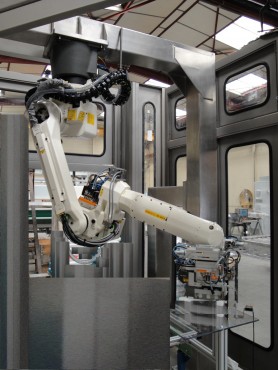




































To deliver high-quality products and keep up with growing demand, more and more pharmaceutical manufacturers are integrating collaborative robot solutions into their production lines. MGA Technologies, a French company, designs and integrates these solutions. Why choose a collaborative robot for pharma, and what can it do? This guide gives you an overview. MGA Technologies designs custom assembly and transfer machines for this type of production.
Why A Collaborative Robot For Pharmaceutical Laboratories?
Many constraints are imposed on healthcare professionals, particularly in the pharmaceutical industry. In addition to frequent changes in standards and legal requirements, the needs of consumers are also constantly on the rise. Not to mention the competition between the various companies, which is becoming ever tougher with the introduction of new technological solutions.
For these and many other reasons, manufacturers are increasingly integrating collaborative robot solutions for pharma into their process lines. The goal is to comply with current manufacturing standards. The use of collaborative robots, or cobots, in factories helps ensure the quality of medicines. It also increases the production capacity of the plant, and therefore the company’s revenue, thanks to a higher production rate. Finally, it reduces the repetitive tasks assigned to employees and helps fill positions for which labor is difficult to recruit.
Many sectors can adopt cobot solutions: pharmaceuticals, biotechnology, cosmetics, mechanical and electronics industries, etc.
A New Generation of Robots
Collaborative robots work differently from conventional industrial robots. Cobots generally have more compact and more flexible robotic arms. Unlike traditional robots, they can perform a variety of tasks in many types of environments, with simpler programming and only minor changes to the line. Their deployment cost is also lower.
Working Alongside People
Collaborative robot solutions for the pharmaceutical sector are designed to work next to people and take over the most strenuous parts of a task. This is often called “coactivity”: robots and operators interact safely in the same space. On a pharmaceutical production line, cobots and operators can take turns on the same task (indirect collaboration) or work on a shared task at the same time (direct collaboration).
Greater Safety
Cobots do not need the safety cages used around traditional robots. Instead, they carry sensors that detect the slightest risk of impact or collision, and they stop immediately if a hazard appears.
Several Programming Options
Cobots for the pharmaceutical industry can be programmed in several ways. Intuitive software is the most common approach, and some cobots can also be programmed by demonstration (teach mode).
Collaborative Robots for a More Productive and Competitive Pharma Industry
Collaborative robots should not be seen as a threat to jobs. On the contrary, they are a key lever for developing an organization.
Productivity Gains
Cobots deliver higher, faster output at a more affordable deployment cost, which shortens the return on investment (ROI). Production costs drop significantly, which strengthens your competitiveness. By cutting costs, making better use of resources and speeding up processes, cobots increase operational efficiency and free up budget for innovation.
Easy Deployment
Pharmaceutical cobots are light and compact, so they fit into tight spaces. With MGA Technologies’ turnkey cobot solutions, you don’t have to worry about installation: our team handles your production line modernization project from start to finish. We start by analyzing your needs, then select the right cobot. Our engineers install it, train your staff, and provide ongoing support to keep it running at its best.
Accessibility
Cobots take over low-value, highly repetitive tasks such as pick and place or case packing of pharmaceutical products, so your teams can focus on higher-value work. Programming the cobots becomes a task that any employee can learn, even a beginner. The time saved translates into cost savings, more room for innovation, and better working conditions for every team member.
Flexibility
Because they are easy to reprogram and redeploy, cobots can be assigned to many different tasks. With new programs and additional tooling, they adapt to the changing needs of the pharmaceutical industry: safe handling of sensitive products, packaging, precise labeling, and working with people on more efficient R&D processes.
Safety
Cobots for the pharmaceutical industry are designed to work safely with people. Their force-torque sensors detect any impact or collision with an operator. The collaborative robot solutions deployed by MGA Technologies meet the regulatory and normative requirements of the sector and can be used in cleanrooms or in confined, sterile environments.
Different Applications For Pharmaceutical Laboratories
Depending on their type, collaborative robot solutions for pharma can be used in various applications.
You can use them to make your workplace safer. Collaborative machines can replace operators when handling hazardous materials or performing tasks in dangerous areas. This is the case, for example, in the processing of active ingredients. All the related steps can be entrusted to robots as long as they offer a “pick and place” function. When these operations are carried out manually, your employees are exposed to risks of varying severity, such as hot liquids, ambient heat, hot steam, etc.
Collaborative robots can also assist you in the separation of liquids. They can handle various types of liquids, regardless of their density and solubility. With this equipment, the risks of accidental spills, explosions, fires and other incidents are greatly reduced.
In addition, pharmaceutical cobots can handle product packaging on the production line. Since they can fill, close and box products, they help ensure product quality. Other collaborative robots can be used to check product quality. Some models can, for example, check the active substance content of a pharmaceutical product. To meet the standards, the product must go through a quality inspection process carried out with the cobot. Many other functions are offered by collaborative robot solutions for pharma: machine loading, screwing, vision, laboratory testing, education and training, etc.
To determine your needs in terms of collaborative robot solutions for pharma, call on a company that specializes in the field. Choose cobots from MGA Technologies, which combine quality, robustness, ergonomics and performance. You will be able to customize your equipment according to the needs of your activities. Do not hesitate to contact us for more information.
MGA Technologies, Your Partner Toward Industry 4.0
MGA Technologies supports your transformation toward Industry 4.0. We are a French company that brings together people passionate about engineering and technology: robotics, mechatronics, automation and AI. Our goal is to deliver innovative, high-performance robotic solutions to companies modernizing for the factory of the future.
MGA Technologies designs and develops a range of collaborative robot solutions for the pharmaceutical sector, including an automatic filling line for heat-sealed plastic strips, a dispensing machine for diagnostic tubes, a glass vial and bottle laser marking machine and a robotic cell for FSI Mercury loading automation. All of this equipment complies with current standards and regulations for quality risk management. It is well suited to cleanrooms and confined, sterile environments, and helps you comply with Good Manufacturing Practices (GMP). See also our expertise in automation and robotics.
Cobots are also a strong fit for industrial assembly: see our collaborative robots for component assembly. Call on MGA Technologies for custom cobot solutions: our engineers assess your needs before designing and building your robotic solution. Contact our team of experts for a free, tailored quote.


